Sundarbans: Where Every Tide Tells a Story
The Forest That Defines Bengal
There are places you visit, and then there are places that stay with you forever. The Sundarbans, a UNESCO World Heritage Site and the largest mangrove forest in the world, is one such place. Stretching across India and Bangladesh, this vast network of rivers, creeks, mudflats, and mangrove islands forms one of the most unique ecosystems on Earth. While nearly two-thirds of the Sundarbans lies in Bangladesh and about one-third in India, the Indian Sundarbans is home to a significant portion of the region's famous Royal Bengal Tiger population.
For Bengal, the Sundarbans is a matter of pride. For India, it is one of the country's greatest natural treasures. But beyond the tigers and wildlife, the Sundarbans is a story of survival — of people, animals, and nature adapting every single day to one of the harshest environments on the planet. It is a landscape where tides dictate life, where rivers create and erase islands, and where every living creature fights a daily battle to survive.
The People Who Enter the Forest
The story of the Sundarbans begins not with tourists, but with the people who call this region home. Every morning, honey collectors, known locally as Moules, and crab collectors prepare to enter the forest. Usually travelling in groups of two to four, they venture deep into the mangrove wilderness in search of a livelihood. For many families living along the fringes of the forest, there are no alternatives. The forest provides income, food, and opportunity.
Yet every journey comes with risk. The Sundarbans is one of the few places in the world where humans and tigers share such close proximity. Every year, lives are lost to tiger attacks, crocodiles, storms, and accidents in the treacherous waterways. Despite the dangers, they continue because survival demands it. Every trip into the forest carries uncertainty, but staying home often isn't an option.
Bonbibi: The Goddess of the Sundarbans
Before entering the forest, these men stop at shrines dedicated to Bonbibi, the guardian deity of the Sundarbans. Perhaps one of the most beautiful traditions of this region is that both Hindus and Muslims worship Bonbibi. In a time when religious differences often dominate headlines, the people of the Sundarbans have preserved a culture where survival matters more than division.
Standing before Bonbibi, they pray for protection against danger, especially against the Royal Bengal Tiger. They seek blessings before stepping into a wilderness where every creek and every patch of mangrove could conceal danger. To outsiders, it may appear to be a simple ritual. To the people of the Sundarbans, it is faith, hope, and courage combined into one.
A Forest Built for Survival
The Sundarbans itself is unlike any forest on Earth. It is home to more than 80 species of mangroves and mangrove associates, including Sundari, Gewa, Goran, and Keora, from which the region derives its name. These remarkable trees have evolved to survive in saline water and constantly shifting tides. Their roots rise above the mud like natural sculptures, creating an almost prehistoric landscape.
The wildlife here is equally extraordinary. Apart from the Royal Bengal Tiger, the forest supports spotted deer, wild boars, fishing cats, smooth-coated otters, rhesus macaques, saltwater crocodiles, water monitor lizards, and countless aquatic species. The birdlife is spectacular, attracting birdwatchers and wildlife photographers from around the world. Species such as the Black-capped Kingfisher, Brown-winged Kingfisher, White-throated Kingfisher, Common Kingfisher, Lesser Adjutant Stork, Brahminy Kite, egrets, and herons are regularly seen throughout the region.
Life here is never easy. Every six hours, the tides transform the landscape. Water levels can rise and fall dramatically, flooding channels and exposing mudflats. The soil is soft clay, causing animals to sink deep into the mud with every step. Freshwater is scarce because most of the waterways are saline. Every creature, from the tiger to the smallest bird, must constantly adapt. Hunting is difficult. Finding drinking water is difficult. Even movement is difficult. Yet despite these challenges, life flourishes here against all odds.
The Wildlife Photography Expedition
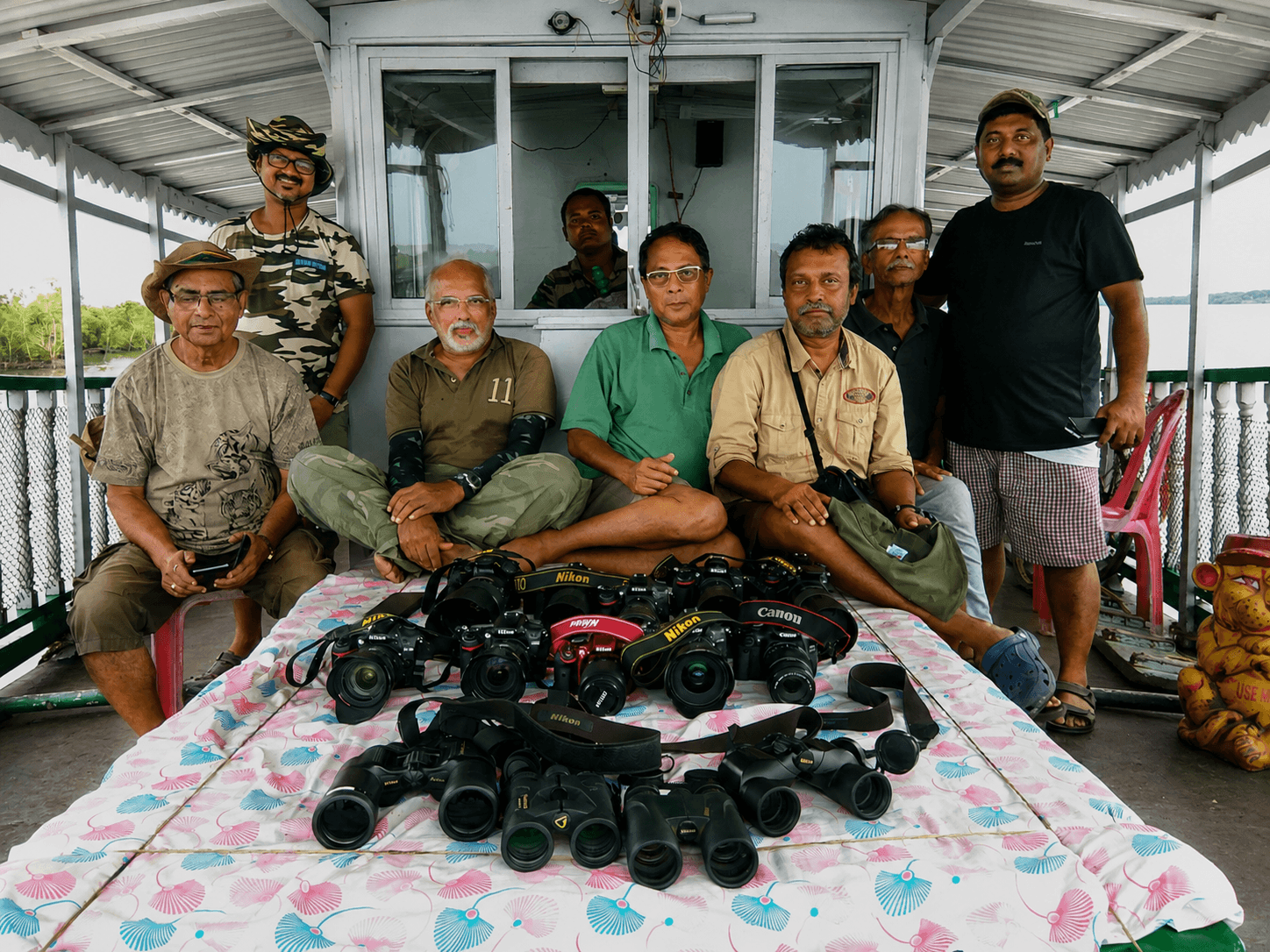
It was in this extraordinary wilderness that one of our most memorable wildlife photography expeditions took place. Several years ago, seven renowned wildlife photographers approached my father, Mr. Samir Saha, who is well known among wildlife photographers and naturalists for his extensive experience in the Sundarbans. Their objective was ambitious but clear: they wanted to photograph a tigress and her two sub-adult cubs that had been sighted in a particular region of the forest over the previous weeks.
The evening before the expedition began, discussions continued late into the night. Guides, local trackers, boatmen, and experienced forest observers shared information gathered from recent sightings. Which islands had the tigress been using? Had she hunted recently? Were there dominant male tigers nearby? Was she likely to cross channels in search of prey? Every clue mattered because tiger tracking in the Sundarbans is vastly different from tracking tigers in other Indian forests. Here, tides influence movement, prey distribution changes constantly, and dense mangroves often hide even the largest predators.
Tracking the Tigress
Before sunrise the following morning, the expedition set out. Two boats were assigned to cover different sectors around the islands where the tigress had most recently been reported. From dawn until sunset, the photographers scanned creek banks, mudflats, and mangrove edges. Breakfast was served on the boat. Lunch was served on the boat. Evening tea was served on the boat. The search never stopped.
While the primary goal was tiger photography, the Sundarbans continued to reward patience with its incredible biodiversity. The photographers captured stunning images of Black-capped Kingfishers, Brown-winged Kingfishers, White-throated Kingfishers, and Common Kingfishers. They photographed the majestic Lesser Adjutant Stork, one of the largest birds found in the Sundarbans, along with several species of egrets and the elegant Brahminy Kite soaring above the rivers. Reptiles also made appearances. A large water monitor lizard basked along a muddy bank while a saltwater crocodile surfaced briefly before disappearing beneath the tide once again.
Three Days of Patience
Despite all these remarkable encounters, there was no sign of the tigress. The first day passed without success. Then came the second. Despite covering multiple creeks and islands, there were no fresh tracks, no reliable reports, and no movement that suggested the tigress was nearby. Slowly, excitement began giving way to impatience. After all, the entire expedition had been built around a very specific objective.
Yet that is precisely what makes wildlife photography so addictive. At any moment, everything can change. Every bend in the river could reveal the impossible. Every rustle in the mangroves could become the moment they had travelled for. Cameras remained ready. Binoculars stayed close. Hope lingered, even as confidence began to fade.
When Destiny Turned the Boat Around
The third day arrived, likely the final day of the expedition. By late afternoon, most of the photographers had almost accepted defeat. The boats had begun making their way back through the creeks and channels. Cameras remained ready, but expectations were low.
Then something unexpected happened.
One of the photographers noticed a Common Kingfisher perched beautifully on a mangrove branch. The lighting was perfect, the background was clean, and the composition was ideal. He requested the boatman to turn around so he could take a few photographs. It seemed like a small decision at the time, but it would soon change everything.
A Rare Encounter in the Mangroves
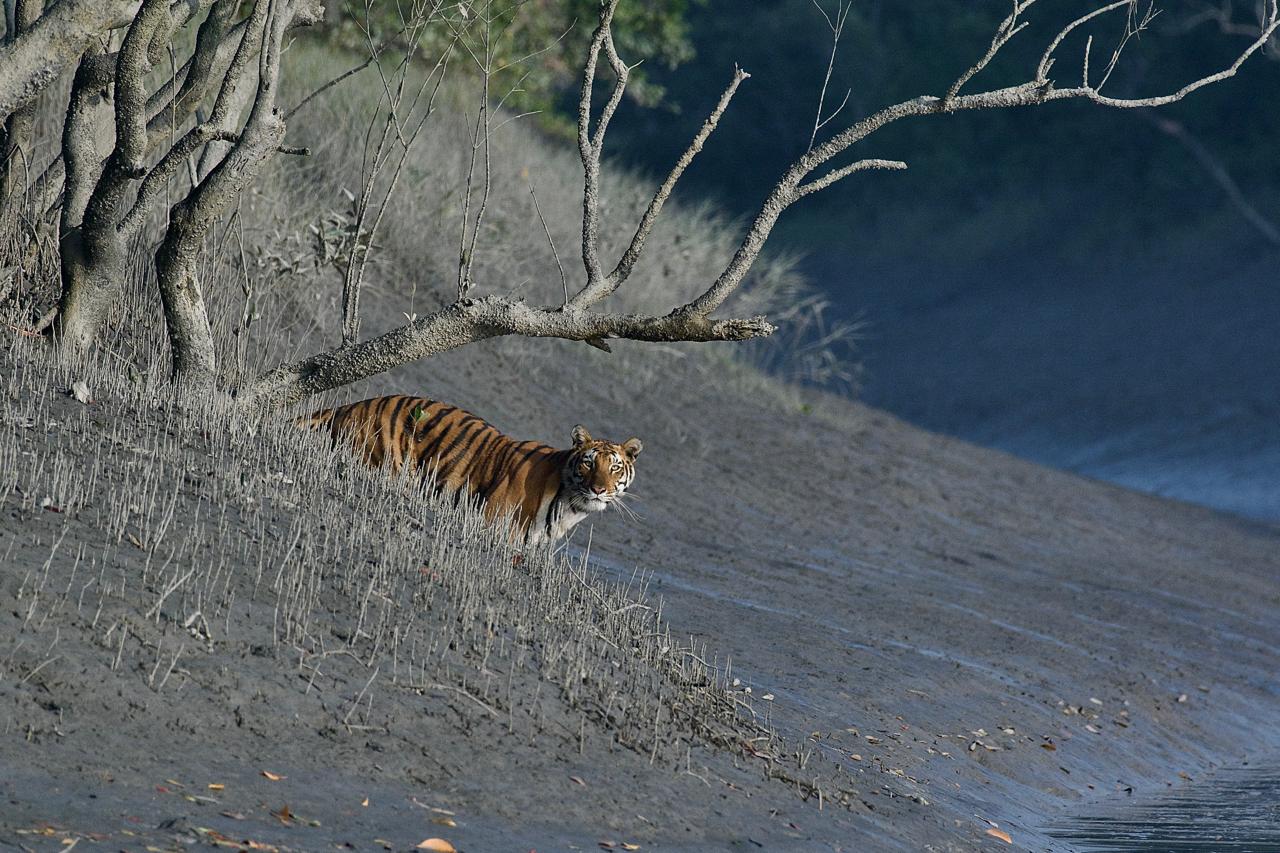
As the boat slowed and cameras focused on the kingfisher, movement was spotted behind it. Emerging silently from the mangroves came the tigress. A few moments later, the first cub appeared behind her. Then came the second.
For a moment, nobody moved. Nobody spoke. The forest itself seemed to freeze.
The tigress approached a narrow tidal creek. One cub crossed first. Then the mother followed. Finally, the second cub crossed behind them. The golden light of the late afternoon illuminated the scene perfectly. Cameras erupted into action as the photographers captured thousands of images in those precious minutes.
Many wildlife photographers spend entire careers without witnessing such a sight. People often say that seeing a tiger in the Sundarbans is like seeing God. Seeing a tigress with two cubs is something even rarer. Looking back, it almost feels as though the kingfisher was never the real subject. Had the boat not turned around for that photograph, the sighting might never have happened.
The Life of a Mother Tigress
The story of that tigress also reveals the challenges of motherhood in the Sundarbans. Male tigers can pose a threat to cubs, and mother tigresses must constantly protect their young. Certain mangrove species develop dense root systems that resemble natural cages. These roots often provide shelter where cubs can remain hidden from danger while their mother hunts or patrols nearby.
Every day becomes a battle for survival. The tides rise and fall. Freshwater remains scarce. Food must be hunted. Danger lurks around every corner. Yet life continues. Not only for tigers, but for every creature that inhabits this remarkable ecosystem. The deer searching for grazing grounds, the crocodile waiting patiently beneath the water, the kingfisher diving for fish, and the honey collector entering the forest all share the same struggle.
Why the Sundarbans Is Unlike Any Other Forest
Perhaps that is what makes the Sundarbans so special. It is not merely a destination where people come to see wildlife. It is a living story of resilience, adaptation, faith, and survival. Every tide changes the landscape. Every season brings new challenges. Every creature has evolved to survive in one of the most demanding ecosystems on Earth.
And once you have experienced it, a part of you never truly leaves.
Sundarbans Travel Guide: Essential Information
Why Visit Sundarbans?
The Sundarbans offers one of the most unique wildlife experiences in the world. Visitors can explore the largest mangrove forest on Earth, search for the legendary Royal Bengal Tiger, witness rare birdlife, discover fascinating island cultures, and experience a UNESCO World Heritage ecosystem unlike any other.
Best Wildlife to Spot in Sundarbans
Royal Bengal Tiger
Saltwater Crocodile
Fishing Cat
Smooth-coated Otter
Spotted Deer
Wild Boar
Water Monitor Lizard
Lesser Adjutant Stork
Black-capped Kingfisher
Brown-winged Kingfisher
Common Kingfisher
White-throated Kingfisher
Brahminy Kite
Egrets and Herons
Best Time to Visit Sundarbans
The best time to visit Sundarbans is from October to March, when the weather is pleasant, visibility is excellent, and wildlife activity is at its peak.
How to Reach Sundarbans
Most visitors travel via Kolkata, followed by a road transfer to Godkhali Jetty and a scenic boat journey into the Sundarbans.
Wildlife Photography in Sundarbans
The Sundarbans is widely regarded as one of the most challenging wildlife photography destinations in India. Success depends on patience, local expertise, understanding of tides, and a fair amount of luck.
Plan Your Sundarbans Tour from Anywhere in the World
Whether you are searching for a Sundarban tour from Delhi, Mumbai, Bangalore, Chennai, Hyderabad, Pune, Ahmedabad, Surat, Jaipur, Lucknow, Chandigarh, Kochi, Trivandrum, Coimbatore, Bhubaneswar, Guwahati, Patna, Ranchi, Nagpur, Indore, or a Sundarban tour package from Kolkata, the Sundarbans remains one of India's most extraordinary wildlife destinations. We specialize in Sundarban wildlife photography tours, Sundarban birdwatching tours, Sundarban luxury tours, Sundarban deluxe tours, Sundarban honeymoon packages, Sundarban family tours, Sundarban corporate tours, Sundarban educational tours, and customized wildlife expeditions.
International travellers frequently visit the Sundarbans from the United States, United Kingdom, Canada, Australia, New Zealand, Germany, France, Netherlands, Switzerland, Belgium, Italy, Spain, Sweden, Norway, Denmark, Singapore, Malaysia, and Japan. Whether you are a wildlife enthusiast, photographer, researcher, conservationist, birder, or nature lover, the Sundarbans offers an unforgettable journey into one of the last great wildernesses on Earth.